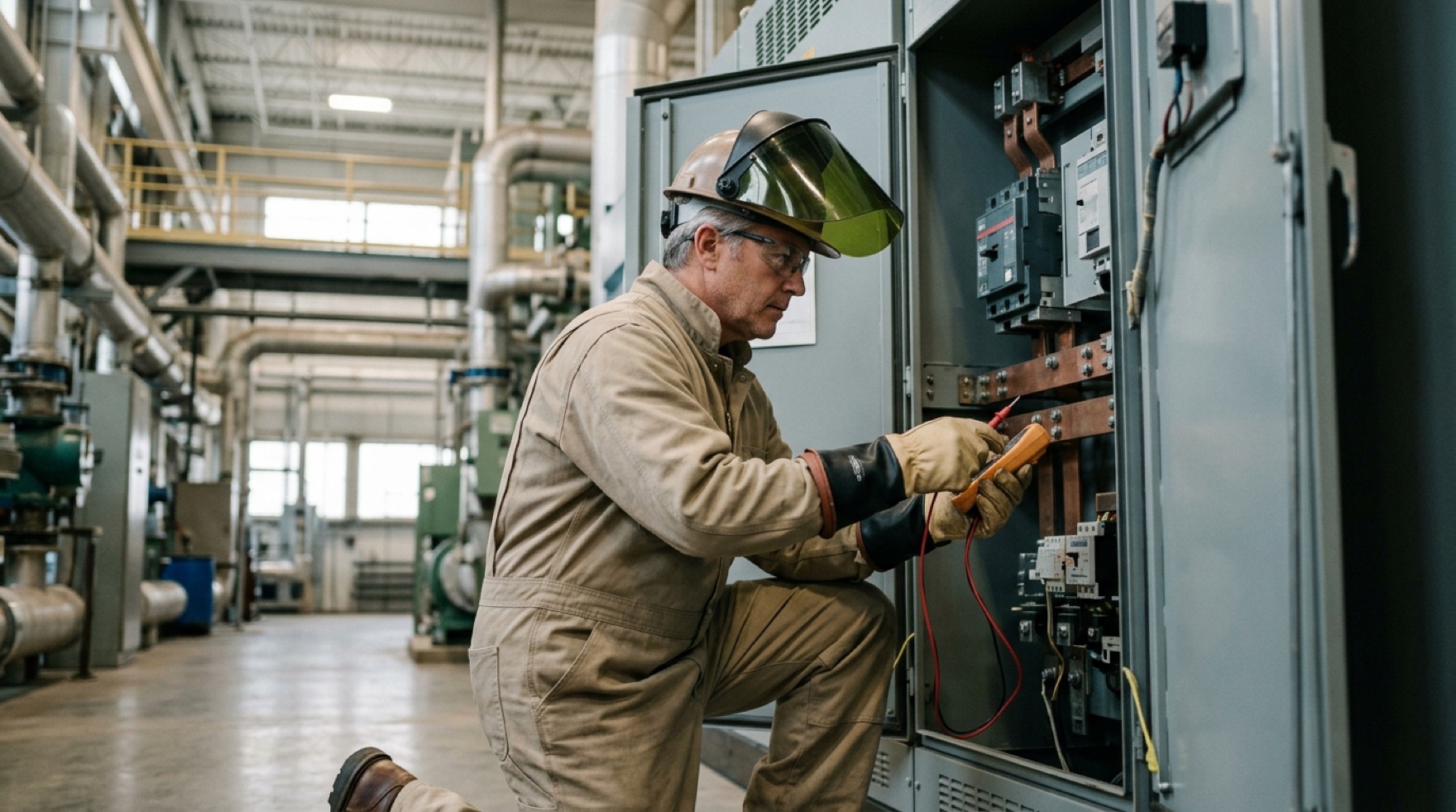
The short answer: An NFPA 70E electrical safety program makes an electrically safe work condition the default, requires a shock and arc-flash risk assessment whenever work has to be done energized, applies the hierarchy of risk control before it reaches PPE, and proves through training that each person doing the work is qualified. NFPA 70E is a consensus standard, not an OSHA regulation. OSHA enforces electrical safe work practices through its own rules in 29 CFR 1910.331 through 1910.335 (Subpart S), and references NFPA 70E, which OSHA notes was originally developed at its request, as the industry method that helps employers comply. The program is what connects the two.
Is NFPA 70E an OSHA standard?
No. NFPA 70E is a consensus standard published by the National Fire Protection Association, and adopting it is not the same as complying with a regulation, because OSHA cannot cite an employer for violating NFPA 70E by name. What OSHA can cite are its own enforceable electrical rules in 29 CFR 1910 Subpart S, chiefly the safety-related work practices in 1910.331 through 1910.335. OSHA's electrical guidance describes NFPA 70E as an industry standard that was "originally developed at OSHA's request" and that "assists in complying with OSHA 1910 Subpart S," which is the accurate relationship: the regulation sets the legal floor, and the consensus standard supplies the detailed method for meeting it.
That distinction matters operationally because it tells a safety leader where the authority actually sits. The OSHA rules are written in terms of outcomes: deenergize before working, use qualified people, provide protective equipment. NFPA 70E fills in the how, with the risk-assessment steps, approach boundaries, incident-energy calculations, and PPE selection tables that the regulation does not spell out. Where a Subpart S rule is silent on a specific control, OSHA can still act under the General Duty Clause of the OSH Act, which requires employers to address recognized hazards, and arc flash is a recognized hazard. Building the program around NFPA 70E is how an employer demonstrates it recognized the hazard and used a credible method to control it.
What has to be in an electrical safety program?
The program has to establish deenergized work as the norm, define who is qualified, set the risk-assessment and control process for the exceptions, and hold itself accountable through auditing. Those are the load-bearing pieces, and each one maps to something OSHA can inspect. The table at the end of this section condenses them; the paragraphs that follow explain the two that employers most often get wrong.
The first is the default. 29 CFR 1910.333(a)(1) requires that live parts to which an employee may be exposed be deenergized before the employee works on or near them, "unless the employer can demonstrate that deenergizing introduces additional or increased hazards or is infeasible due to equipment design or operational limitations." A program that treats energized work as routine has inverted the standard. The correct posture is that establishing an electrically safe work condition is the plan, and energized work is a documented, justified exception that a manager has to approve.
The second is who does the work. 1910.333(c)(2) permits only qualified persons to work on electric circuit parts or equipment that have not been deenergized, and 1910.332(b)(3) defines what qualification means: the person is trained to distinguish exposed energized parts from other parts, to determine the nominal voltage of those parts, and to know the clearance distances and corresponding voltages. A qualification is task-specific and equipment-specific, not a job title. A journeyman card is not, by itself, evidence that someone is qualified for a particular energized task on a particular piece of gear.
| Program element | What it requires | Anchor |
|---|---|---|
| Electrically safe work condition as default | Deenergize before working unless deenergizing adds hazard or is infeasible | 29 CFR 1910.333(a)(1) |
| Qualified persons only on energized parts | Only trained, qualified persons work on parts not deenergized | 1910.333(c)(2); 1910.332(b)(3) |
| Shock and arc-flash risk assessment | Assess the shock and arc-flash hazard before energized work; identify boundaries and incident energy | NFPA 70E, Art. 130 (consensus) |
| Hierarchy of risk control | Eliminate, then substitute, engineer, use warnings and administrative controls, then PPE | NFPA 70E, Art. 110 (consensus) |
| Protective equipment | PPE appropriate for the body part and the work; maintained and inspected | 1910.335(a)(1)(i)-(ii) |
| Training and retraining | Train per job assignment on the practices in 1910.331 to .335 | 1910.332(b) |
How do you decide whether work can be done deenergized?
Start from the assumption that it can, then require a documented justification to do anything else. Under 1910.333(a)(1), inconvenience, production pressure, and the time it takes to shut down are not acceptable reasons to work energized; the only recognized grounds are that deenergizing would introduce a greater hazard, such as shutting down life-safety ventilation or emergency lighting, or that it is genuinely infeasible because of equipment design or an operational limitation. Most tasks that get done live could be done dead with better planning.
When energized work does clear that bar, the program moves into risk assessment. NFPA 70E's method, in its Article 130, calls for a shock risk assessment that identifies voltage and the approach boundaries around exposed parts, and an arc-flash risk assessment that determines the incident energy, or the appropriate PPE category, and the arc-flash boundary. Those outputs are what a manager signs off on when authorizing energized work, and they are what tell the qualified person which protective equipment and which boundaries apply. The assessment is not paperwork for its own sake: it is the step that converts "this looks dangerous" into specific, defensible numbers that drive the controls.
The program should also make the assessment reusable. Because incident energy and boundaries depend on the equipment's fault current and clearing time rather than on the individual worker, the results belong on the equipment itself, on an arc-flash label, and in the procedure for the task, so the next qualified person does not start from zero. That is how the assessment stops being a one-time document and becomes an operating input: the label says what the exposure is, the procedure says how to control it, and the permit records that a manager weighed the justification against those known numbers before the work went ahead.
Why does the hierarchy of control come before PPE?
Because PPE is the last layer, not the first, and a program that leads with it is protecting against the consequence instead of removing the cause. NFPA 70E, in Article 110, requires applying the hierarchy of risk control: eliminate the hazard first, then substitute, then use engineering controls, then awareness and administrative controls, and only then arc-rated PPE. Elimination, in electrical work, usually means creating an electrically safe work condition, which is why deenergizing sits at the top and PPE sits at the bottom.
The operational point is that arc-rated clothing and insulating gloves reduce the severity of an event that has already started; they do nothing to stop the event from starting. A worker in a 40 cal/cm² suit standing in front of energized 480-volt gear is still exposed to the arc flash and arc blast, just with a better chance of surviving it. So the program should treat every requirement for heavy PPE as a signal to ask whether the task could have been done deenergized, and should make that question part of the energized-work authorization rather than an afterthought. PPE is the control you rely on when the higher controls could not be applied, not the control you reach for first.
How do you keep the program credible over time?
Tie it to training, provisioning, and auditing, because a program is only as real as the last time someone checked it against the floor. 1910.332(b)(1) requires employees to be trained in and familiar with the safety-related work practices in 1910.331 through 1910.335 that pertain to their job assignments, and 1910.335(a)(1)(ii) requires that electrical protective equipment be maintained in a safe, reliable condition and be periodically inspected or tested. Insulating gloves that are never tested and a qualification that is never refreshed are gaps that an incident, or an inspector, will find.
Effective programs close the loop three ways. They keep a current list of who is qualified for which tasks and equipment, and they retrain when the equipment, the procedures, or a person's role changes. They provision and test the protective equipment on a schedule, so the arc rating on the label still means something. And they audit the field work against the written program, because the failure mode is almost never the absence of a program: it is a program that exists on paper while energized work happens without the assessment, the boundaries, or the qualified person the program requires. The value of NFPA 70E is realized only when the document on the shelf matches the decision a worker makes in front of a live panel.