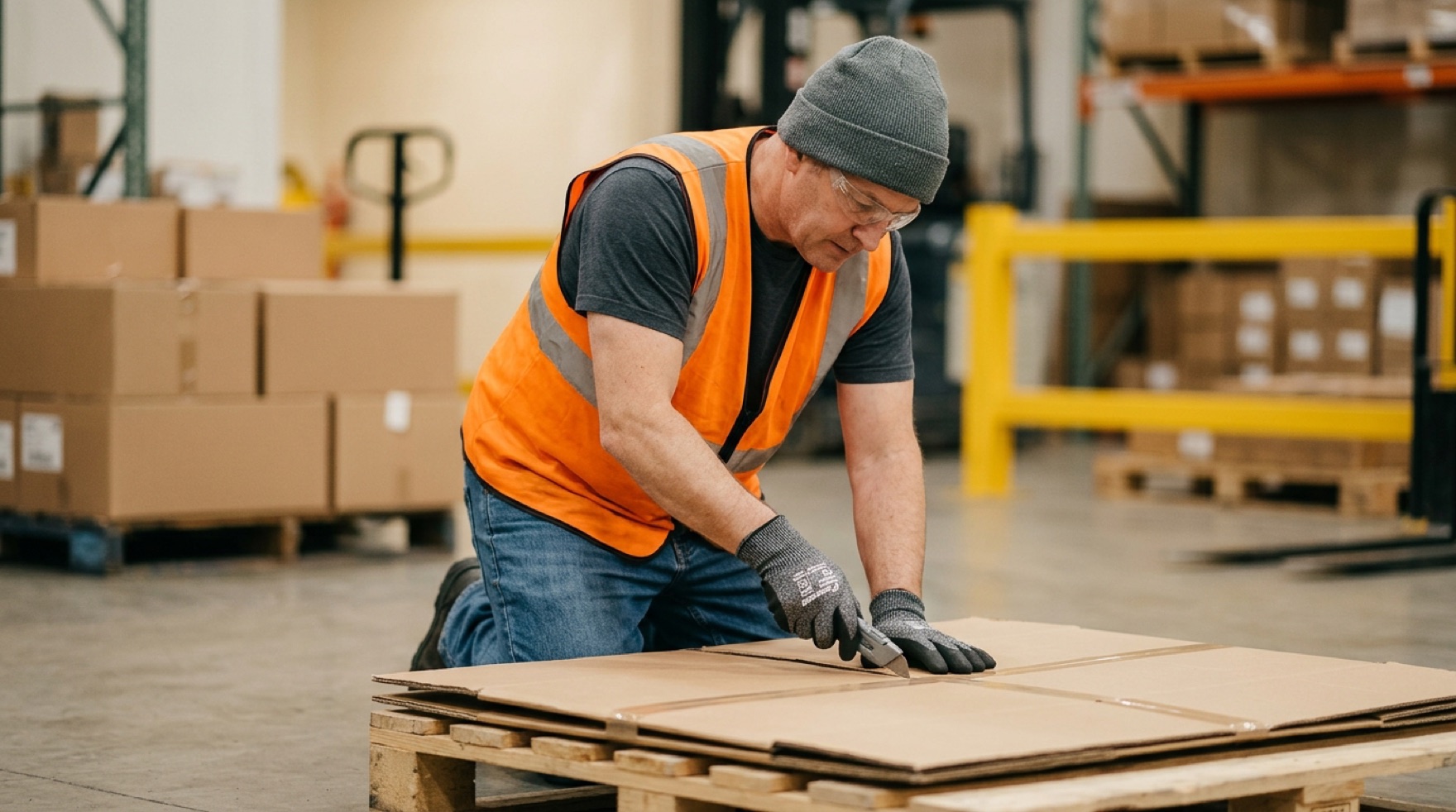
The short answer: Box-cutter lacerations in retail are controlled first by eliminating or shielding the blade, safety knives with self-retracting or concealed blades, and cutting away from the body, and only then by cut-resistant gloves where a manual blade stays in use. When you do specify gloves, match them to the cut hazard using the ANSI/ISEA 105 classification, which rates cut resistance on a nine-level A1 to A9 scale by the grams of load a blade needs to cut through the material, measured by the ASTM F2992 (TDM-100) test method. Most retail carton-opening lands at level A2 to A4. The legal driver is 29 CFR 1910.132(d), which requires the employer to assess the hazard, select PPE that matches it, and certify that assessment in writing.
What does OSHA require before you hand out cut-resistant gloves?
OSHA does not name a cut level, but it does require the employer to do the assessment that leads to one. 29 CFR 1910.132(d)(1) requires the employer to assess the workplace to determine whether hazards are present that necessitate PPE, and if so to select PPE that will protect the affected employee from the hazards identified. 1910.132(d)(2) requires that assessment to be verified through a written certification identifying the workplace evaluated, the person certifying, and the date, and identifying the document as a certification of hazard assessment.
For a store that means walking the actual cutting tasks, opening cartons on truck day, cutting shrink wrap and strapping, breaking down boxes, before deciding on a glove. The assessment is what connects a specific task, such as slicing toward a gloved hand to open a case, to a specific control. Buying a box of gloves without that step satisfies neither the standard nor the worker, because the glove that stops a light utility blade at the shelf is not necessarily the one needed where heavier blades and metal strapping are handled.
How do ANSI/ISEA 105 cut levels A1 to A9 actually work?
ANSI/ISEA 105 classifies a glove's cut resistance by how much weight a blade needs to slice through the material in a single pass, reported as one of nine levels from A1 to A9. The test method is ASTM F2992 using the TDM-100 machine, which draws a straight blade across the material under increasing load and records the grams required to cut through at 20 mm of blade travel, using a fresh blade to account for dulling. A higher number means more grams of load, which means more protection.
The standard classifies cut resistance separately from puncture resistance and abrasion resistance, so a cut rating says nothing about needle-stick or puncture protection, which carry their own scales. That distinction matters in retail, where the hazard is a slicing blade rather than a point, so the cut level is the number to specify. The table below gives the full A1 to A9 scale with the grams range for each level and where each band tends to fit retail work.
| ANSI/ISEA 105 level | Cut resistance (grams) | Typical retail fit |
|---|---|---|
| A1 | 200 to 499 | Light material handling; minimal blade contact |
| A2 | 500 to 999 | General carton opening with a self-retracting safety knife |
| A3 | 1,000 to 1,499 | Frequent box-cutter use; facing and breakdown on truck day |
| A4 | 1,500 to 2,199 | Heavy carton volume, exposed utility blades, some strapping |
| A5 | 2,200 to 2,999 | Metal strapping and banding; sharper, heavier blades |
| A6 | 3,000 to 3,999 | High cut exposure; back-of-house with sharp edges and glass |
| A7 | 4,000 to 4,999 | Beyond typical retail; sheet metal, heavy glass handling |
| A8 | 5,000 to 5,999 | Beyond typical retail; extreme blade contact |
| A9 | 6,000 and above | Beyond typical retail; heavy fabrication and recycling |
Most retail carton and shelf work sits in the A2 to A4 band. Reserve A5 and above for tasks that add metal strapping, glass, or heavier blades, and recognize that A7 to A9 gloves are built for fabrication and recycling rather than a sales floor. Do not read across to European ratings without care: EN 388 reports cut resistance from a different test, the Coupe test for lighter materials and the ISO 13997 method for tougher ones, so an EN 388 letter is not the same as an ANSI A level.
How do you choose the right level without over-gloving?
Match the level to the sharpest realistic blade and the most exposed motion in the task, then stop there. A higher cut level generally means a thicker or denser glove, which can reduce dexterity and grip feel, and a worker who cannot handle a blade precisely, or who takes the glove off because it is clumsy, is less safe than one wearing a well-matched A3. The goal is the lowest level that reliably covers the hazard the assessment found, not the highest number on the shelf.
Choosing well runs in a short sequence. First, cut the exposure at the source: switch to safety knives with self-retracting or concealed blades so the edge is exposed only during the cut, and train cutting away from the body and the opposite hand. Second, identify the sharpest blade and heaviest cutting task in the assessment, because the glove has to cover the worst case, not the average one. Third, pick the ANSI/ISEA 105 cut level that band covers, favoring A2 to A4 for standard carton work and moving up only where strapping, glass, or heavier blades are handled. Fourth, confirm fit and dexterity on the real task, and re-check the choice when the product mix, the blade, or the cutting method changes. Cut-resistant gloves sit near the bottom of the hierarchy of controls, below eliminating and shielding the blade, so they are the last layer rather than the first, and they work only when the level actually matches the cut.