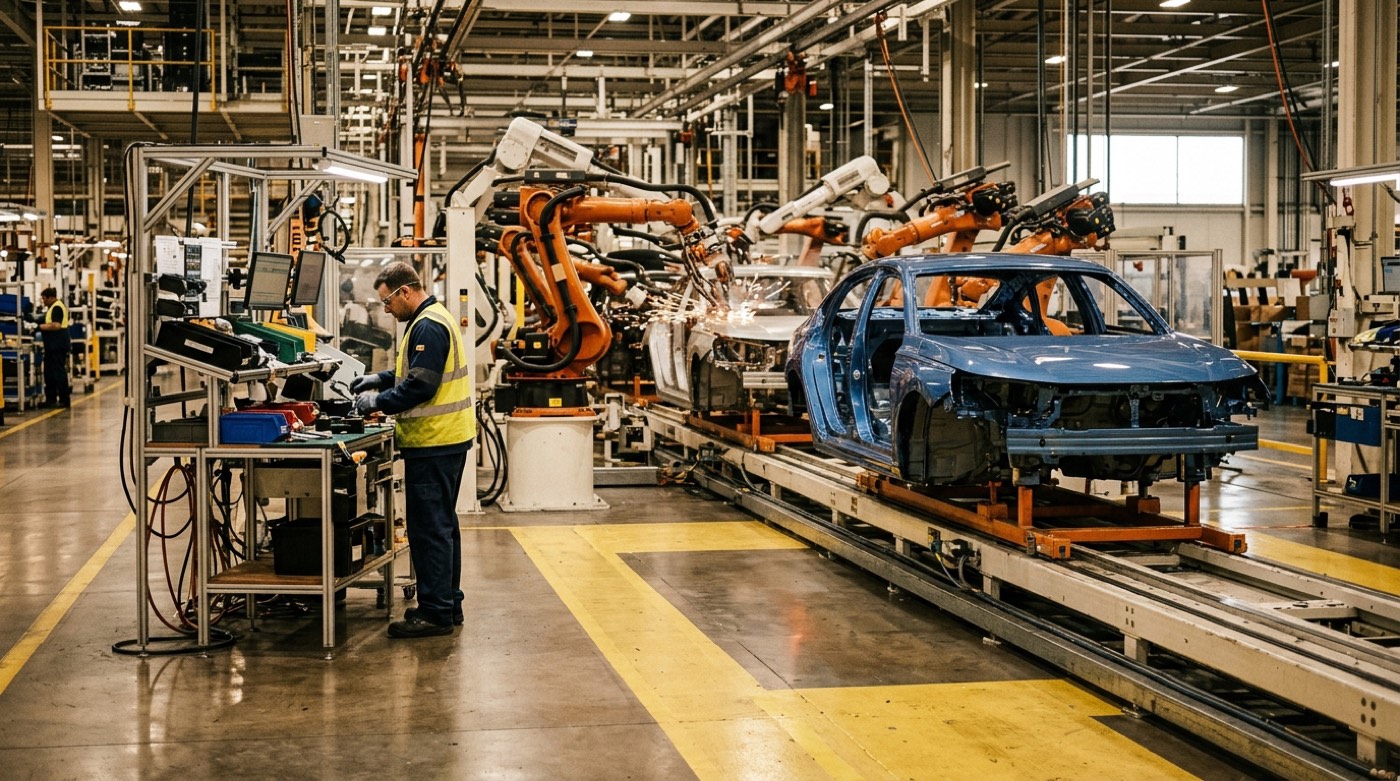
Automotive Manufacturing & Assembly
Where a wet floor, a moving line, and a guarded press share the same aisle.
Automotive manufacturing combines the pace of a moving assembly line with the energy of heavy machinery, powered trucks, and — increasingly — high-voltage EV battery work. The result is a plant floor where the most-cited hazards are also the most preventable: slips on coolant and fluid, overexertion at repetitive stations, and contact with unguarded press, robot, and conveyor motion.
An automotive plant is really several risk environments stacked on top of each other. The finish-and-assembly floor runs on repetitive manual work, where cumulative strain builds quietly. The stamping and body shops run presses, robots, and conveyors capable of amputation-level energy. Logistics aisles carry forklifts and tuggers within feet of walking workers. And process areas leave oil, coolant, and washdown water on hard floors — the single most common source of the slips and same-level falls that dominate the injury log.
The hierarchy of controls organizes all of it: eliminate the spill at its source, drain and guard what remains, and treat matting, footwear, and PPE as the layers that catch what engineering can't. This section maps each hazard to the control that actually moves the injury rate — and shows where a single control, like matting, is one useful layer rather than the answer.
The hazards, and the controls that move the needle
Ordered by the hierarchy of controls — eliminate and engineer first, then treat matting, footwear, and PPE as the layers that catch what remains.
Slips, trips & falls on plant floors
Oil, coolant, hydraulic fluid, and washdown water on hard, flat floors make same-level falls the most frequently recorded plant-floor injury — and the most preventable.
- Fix leaks at the source; contain drips with trays and bunding
- Drainage and spill-capture in wet process zones
- Measured slip-resistant surfaces (DCOF ≥ 0.42, ANSI A326.3)
- Drainage and slip-resistant matting as a surface-level layer
- Documented cleaning cycles and prompt spill response
Manual handling & line ergonomics
Repetitive reaching, lifting, and sustained standing at fixed stations drive musculoskeletal disorders — a leading source of lost-time claims in vehicle assembly.
- Redesign the task: height, reach, and load at the workstation
- Lift assists, tilt tables, and conveyors to remove manual handling
- NIOSH Lifting Equation / RULA screening at the design stage
- Job rotation and micro-breaks for repetitive tasks
- Anti-fatigue matting for stations that must remain standing
Machine guarding — presses, robots, conveyors
Stamping presses, articulated robots, and conveyors carry energy that causes amputations and crush injuries when guards, interlocks, or presence-sensing fail.
- Fixed and interlocked guarding to ANSI B11 / OSHA Subpart O
- Presence-sensing devices and two-hand controls on presses
- Robot safeguarded space per ANSI/RIA R15.06 (ANSI/A3)
- Conveyor nip-point guarding and emergency stops
- Lockout/tagout for any reach past the guard
Powered trucks & pedestrian separation
Forklifts, tuggers, and AGVs sharing aisles with walking workers produce struck-by fatalities that engineering separation almost always could have prevented.
- Physically separate pedestrian and vehicle routes
- Barriers, gates, and marked crossings at conflict points
- Proximity detection, blue spot lights, and speed limiting
- Operator certification and pre-shift inspection (OSHA 1910.178)
- Right-of-way rules that give pedestrians priority
Hazardous energy during changeover
Model changeovers and maintenance expose workers to stored mechanical, electrical, hydraulic, and pneumatic energy unless it is isolated and verified first.
- Written, machine-specific energy-control procedures
- Isolate, lock, tag, and verify zero energy before work
- Understand the narrow minor-servicing exception (1910.147)
- Group lockout and shift-handoff continuity
- Annual procedure audits (OSHA 1910.147 / ANSI Z244.1)
Electrostatic discharge (EV & electronics)
Controls modules, ECUs, and EV battery electronics are damaged by static discharge invisible to the worker — a quality and rework cost, and a control concern in cell handling.
- ESD control program to ANSI/ESD S20.20
- Grounded ESD flooring/matting within the required resistance range
- Wrist straps, footwear, and continuous monitoring
- Static-safe handling of cells, modules, and PCBAs
- Verification testing per ESD TR53 / IEC 61340-5-1
The programs that anchor the floor
Housekeeping & spill response
A dated, signed cleaning cycle and a fast spill-response standard keep contaminated floors from becoming the plant's default state — the control that most directly lowers same-level falls.
Pre-task energy control
Every reach past a guard or into a changeover starts with isolate-lock-tag-verify. The minor-servicing exception is narrow; when in doubt, lock out.
Ergonomic assessment at design
Screen new and changed stations with NIOSH/RULA before they go live. Matting, rotation, and lift assists are chosen against the assessment, not bolted on afterward.
Traffic management plan
A current map of pedestrian and vehicle routes, crossings, and blind corners — reviewed after every layout change — is the backbone of struck-by prevention.
In-depth guidance
View all 8 →
Slips, Trips & Falls on Automotive Plant Floors: Controlling Oil, Coolant & Fluid Spills
On an automotive plant floor, the injury that shows up most on the log is also the most preventable. Here is how to control the oil, coolant, and washdown water behind same-level falls — engineering the spill out first, and treating footwear and matting as the last layers.

Manual Handling & Ergonomics on the Automotive Assembly Line
Musculoskeletal disorders are the quiet, cumulative injury of the assembly line — built from repetitive reaching, awkward posture, and loads that are a little too heavy, a little too often. Here is how to screen the risk with the tools OSHA and NIOSH actually reference, and design it out at the station.

Machine Guarding for Presses, Robots & Conveyors in Vehicle Manufacturing
Stamping presses, articulated robots, and conveyors carry the energy that turns a momentary reach into an amputation. This is how OSHA's Subpart O and the ANSI B11 and robot-safety standards define adequate safeguarding — and why the guard and the lockout program have to work together.

Powered Industrial Trucks & Pedestrian Separation in Auto Plants
Forklifts, tuggers, and AGVs move parts through the same aisles people walk. When a vehicle and a pedestrian occupy the same space, the outcome is a struck-by injury that engineering separation almost always could have prevented. Here is how to design the conflict out.

Lockout/Tagout During Changeover & Maintenance on the Line
Model changeovers, die changes, and robot-cell interventions are where automotive workers meet stored energy — and where the narrow "minor servicing" exception gets stretched past what it can hold. Here is how to apply OSHA 1910.147 to the changeover, and where the exception really ends.

Slip-Resistant & Drainage Matting for Oil, Coolant & Washdown Areas
In a machining bay or washdown zone, matting is the layer you can see doing its job. But a mat only earns its place after drainage and spill control have done theirs — and only if its slip resistance is a measured value in the contaminated condition, not a claim on the box.

Anti-Fatigue Matting for Standing Assembly Stations: What the Evidence Supports
Anti-fatigue matting is one of the most requested — and most oversold — ergonomic controls on the plant floor. Here is what the peer-reviewed evidence and CCOHS guidance actually say, and how to use matting as the honest, last-layer control it is.

ESD Matting for Electronics, Controls & EV-Battery Assembly
As vehicles fill with control modules and high-voltage battery electronics, electrostatic discharge moves from a quality nuisance to a real control concern. ESD matting is a core part of the answer — but only as one grounded element of a program built to ANSI/ESD S20.20.
Plant-floor slip-resistance check
Where DCOF sits relative to the ANSI A326.3 wet threshold, and how to prioritize floors and matting by contamination.
Read the guide →Assembly ergonomics primer
The risk factors, the screening tools, and where anti-fatigue matting genuinely helps versus where it masks a workstation problem.
Read the guide →Changeover LOTO walkthrough
The six energy-control steps applied to a line changeover, plus the exact limits of the minor-servicing exception.
Read the guide →
Stay ahead of safety.
New articles, free templates, and regulatory updates in your inbox. No spam — unsubscribe anytime.